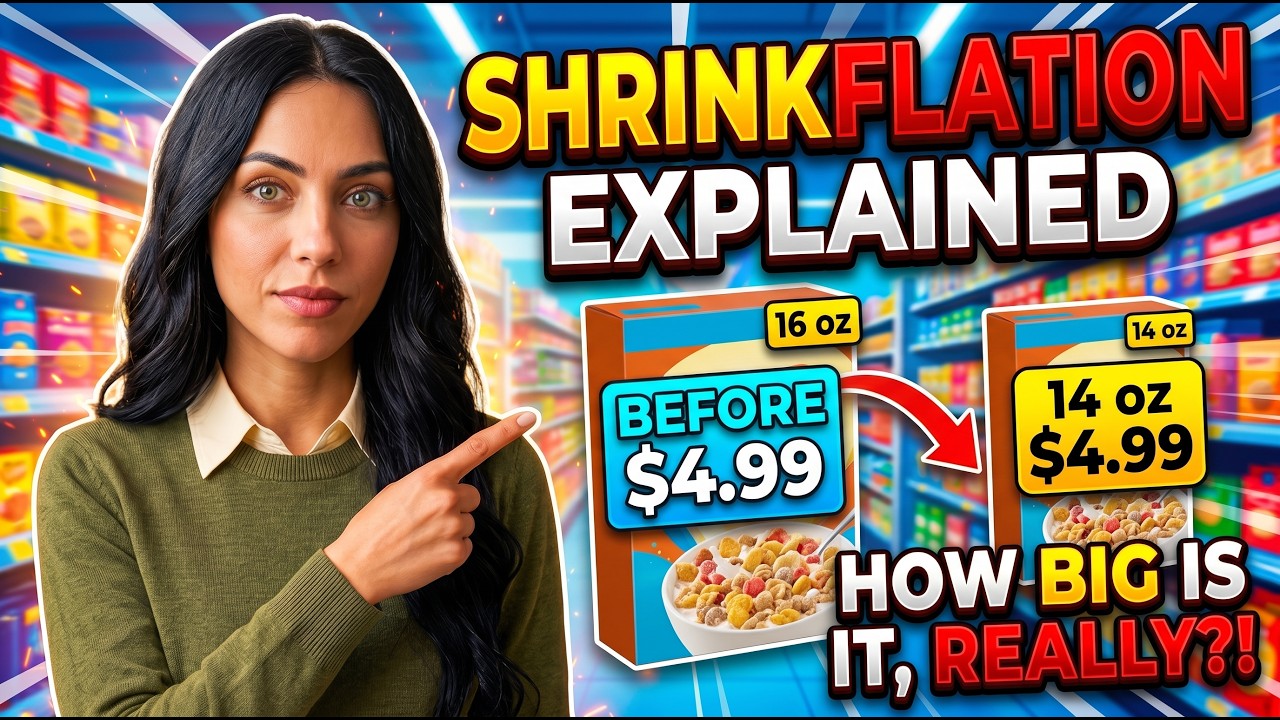
Shrinkflation explained in one line: a package gets smaller, the price stays put, and each unit costs more. It is easy to feel that it is everywhere, but how big is it, really? Two official sources, a Government Accountability Office (GAO) report and a Bureau of Labor Statistics (BLS) article, give a measured answer with two lessons: the overall effect is small, but some products are hit much harder.
Educational only, not financial advice. This article covers shrinking quantity only. Lower quality at the same price is a separate question sometimes called skimpflation. Examples marked hypothetical are illustrations, not real products.
Shrinkflation explained: the definition
GAO defines shrinkflation as less quantity without a matching price drop. According to the BLS explanation, market research suggests manufacturers downsize because consumers are more sensitive to price changes than to size changes. Manufacturers say a smaller package can keep the total price steady when their costs rise, in exchange for less product.
How the government counts it
BLS starts with simple math. For sized items, it computes an effective price per unit, usually per ounce, by dividing price by size. In BLS’s hypothetical ice cream example, a 64-ounce half gallon at $5.99 costs about 9.4 cents per ounce. If the carton shrinks to 60 ounces at the same price, the cost rises to just under 10 cents per ounce, a 6.7% increase in price per ounce even though the receipt never changed.
The method works for items without weights, too. BLS can count toilet paper by the sheet. In a case it describes, a roll dropping from 220 sheets to 200 sheets at the same price counts as a 10% increase in price per sheet. BLS also notes that makers can change a package’s air or a jar’s divot, which makes a shrink easy to miss. Goods sold by exact weight or volume, like gasoline or steak, generally do not get downsized.
How big is it overall?
In its report GAO-25-107451, GAO used BLS data to build modified price indexes. From December 2019 to December 2024, prices in its modified index rose 34.5%. Downsizing contributed about 0.06 percentage points of that, or roughly 0.01 points per year. That is under two tenths of one percent of the rise. These are GAO’s own calculations, not the official CPI.
The total is small because products that actually changed size are a small share of the price sample. Housing, utilities, college tuition, and medical costs are big spending items, and size changes do not apply to them.
Where it adds up: product categories
Zoom in on individual categories and the picture changes. From December 2019 to December 2024, GAO estimates that shrinking packages added the following percentage points to price inflation:
- Household paper products (such as paper towels and toilet paper): 3.0
- Snacks: 2.6
- Candy and chewing gum: 2.3
- Ice cream: 1.8
- Breakfast cereal: 1.6
- Coffee: 1.4
So it is a sliver overall, but a real push in some categories. BLS found a similar pattern in its own research indexes, with household paper products having the most size-change reports.
Few items, bigger share of sales
GAO also studied retail scanner data from NielsenIQ for seven everyday products from 2021 to 2023. In every category, fewer than 5% of items were downsized. But those items can account for more sales than their numbers suggest. In cereal, 60 of 5,591 items, about 1.1%, were downsized, and they made up 8.6% of dollar sales. In paper towels, downsized items were 38.6% of dollar sales, while in pain relievers they were 0.5%. GAO notes the results are not generalizable to all products, and that its counts are a minimum.
Among items that actually shrank, GAO found the average per-unit price increase ranged from 11.6% for paper towels to 32.4% for coffee. Those are averages, not what every shopper paid.
Do shoppers notice?
GAO reviewed studies of consumer behavior. In four product-specific studies, shoppers were about two to five times more responsive to an equivalent price rise than to a size reduction. GAO cautions those studies are not generalizable. In a broader study, a 1% price rise cut sales by nearly 2%, while a 1% smaller size slightly raised packages sold. Three studies found lower-income households reacted more to downsizing than higher-income ones. GAO also notes that, in some cases, shoppers may prefer a smaller package to a higher price, so it can act like a price rise and some shoppers accept the trade.
Shrinkflation explained: the unit price tool
A practical tool is the unit price, the small number on the shelf tag, such as price per ounce. Unit prices do not announce a shrink, but they help you compare even when you never noticed one. GAO reports that, as of November 2024, 16 states, the District of Columbia, and two territories had unit pricing laws or regulations. Elsewhere many stores show unit prices voluntarily. France and South Korea have disclosure requirements for some downsized items, according to GAO.
A hypothetical practice example
Say a bag of snacks goes from 10 ounces to 9 ounces at the same price. Spread the price over 9 ounces instead of 10, and each ounce costs about 11% more. The bag is 10% smaller, yet the price per ounce rises about 11%. That is why unit price helps: it turns a size change into a number you can compare.
Shrinkflation explained: what the data can and cannot say
In the BLS sample, downsizing reports outnumbered upsizing ones by about three to one from 2021 through 2024. In GAO’s modified index the overall effect is tiny, but in some categories it adds up. GAO’s price data end in December 2024 and its scanner data in 2023, so today’s shelves may differ. The estimates rely on a sample, and GAO classified size cuts of 20% or less as downsizing, so different thresholds would give somewhat different numbers.
Shrinkflation explained: what to do at the shelf
- Compare price per unit, not per package, especially on items that tend to shrink.
- Check the unit price on the shelf tag when two sizes or brands look similar.
- Remember the scale. Shrinkflation is real but small overall and larger in some categories.
For other looks at how everyday prices move, read how tariffs affect prices and why vet bills are so expensive, or browse Why Is It So Expensive?.
Frequently asked questions
What is shrinkflation?
It is less quantity without a matching price drop, so the price per unit rises.
How much does shrinkflation add to inflation?
In GAO’s modified index, about 0.06 percentage points from December 2019 to December 2024, though some categories, such as household paper, saw about 3 points.
Is this financial advice?
No. This is general education. Brightward is independent and is not affiliated with GAO, BLS, or any government agency.