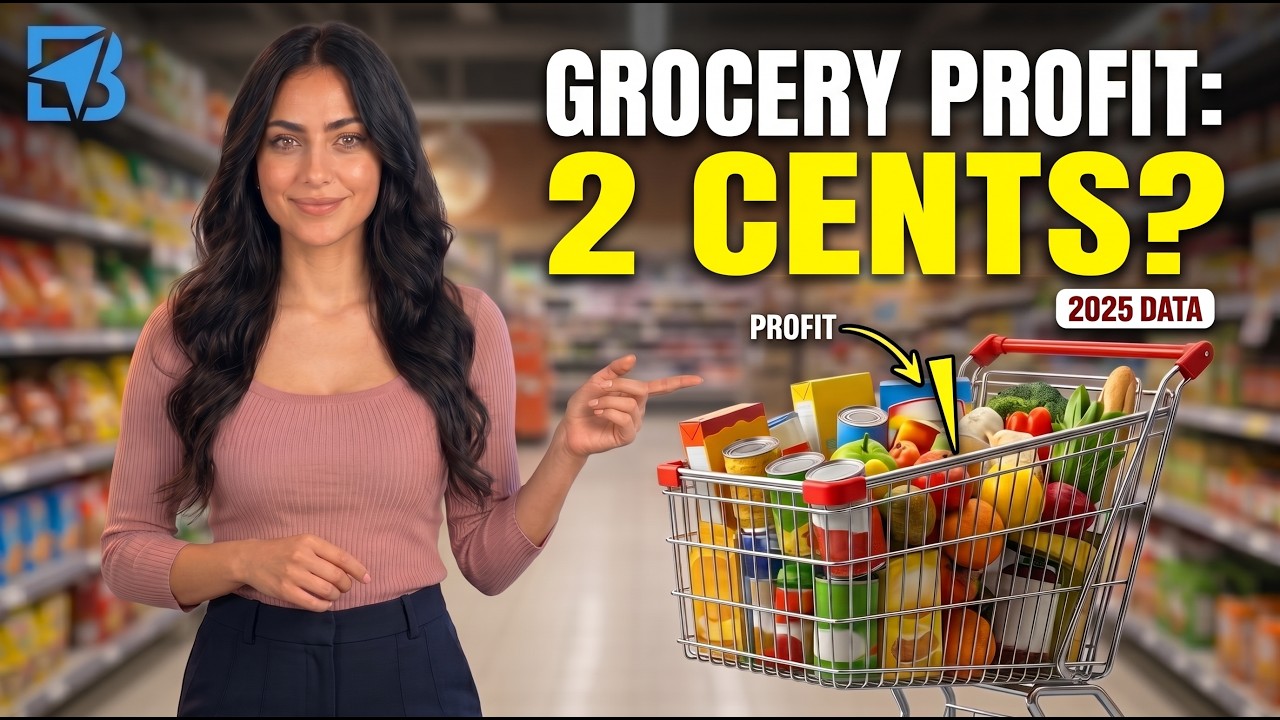
How do grocery stores make money when they keep so little of each dollar? According to industry group FMI, food retailers reported a profit margin of about 2.1% in 2025. That is roughly two cents of every dollar you spend. This article follows the money from the register to the shelf, using one large grocer’s results, an old government study of shelf fees, and two trials that tested whether store layout makes people spend more. The limits of each source are marked.
Educational only. This is not business, legal, or financial advice, and it cannot say what any store earns. The figures come from different years and sources, so they should not be read as one picture of every store.
How do grocery stores make money on a 2.1% margin?
FMI’s report The Food Retailing Industry Speaks 2026 says food retail profit margins in 2025 were up slightly at 2.1%. FMI uses the words “profit margins” without saying whether the figure is net after tax, so we quote it as published. A store with thousands of products, many workers, and rows of refrigerators runs on pennies, which leaves little room for error.
How do grocery stores make money? Gross margin versus what is left
Gross margin is what a store has left after it pays for the goods it sells. Kroger, a large American grocer, reported a full-year 2025 gross margin of 22.9% on sales of $147.6 billion. In its report, the merchandise costs behind that figure include advertising, warehousing, and transportation. So a little under a quarter of each dollar was left after the goods.
Wages, rent, energy, and refrigeration all have to come out of that money. Kroger reported net earnings of 0.7% of sales for the same year. That year included a $2.5 billion impairment and related charge on its automated fulfillment network, so it is not a typical year. It is one company, not the whole industry, but it shows why a small margin leaves little room for error.
What Kroger calls alternative profit businesses
Kroger also reported $1.5 billion in operating profit from what it calls alternative profit businesses, compared with adjusted operating profit of about $4.9 billion. That is roughly three tenths, though the release does not say that the $1.5 billion is part of the $4.9 billion, and it does not say what those businesses include. It does show that a grocer’s profit can come from beyond the aisles.
How do grocery stores make money from suppliers? Slotting fees
When a supplier wants a new product on a shelf, the store may charge a fee called a slotting allowance. In 2003, the Federal Trade Commission studied these fees in five product categories: fresh bread, hot dogs, ice cream and frozen novelties, shelf-stable pasta, and shelf-stable salad dressing. In its staff report the FTC found considerable variability across categories, and that for some products the fees were a large part of first-year revenue. Most surveyed retailers said the fees help cover the costs of introducing new products, and the fees were less common and smaller when suppliers delivered straight to stores.
The FTC also said its sample of case studies was small and may not represent all retailers, and the study is over twenty years old. So we cannot say how much of a store’s income comes from these fees today.
How do grocery stores make money from store brands? Private label
Store brands, also called private label, made up about 21% of dollar sales in 2025 (21.3%), according to the trade group PLMA, using Circana data. That figure covers all kinds of outlets, not only grocery stores. It also says nothing about how much profit store brands earn, and we did not find a source that measures that. You may hear that store brands earn more, which could be true, but without a source we do not claim it.
Does store layout make you spend more?
You have probably heard that stores arrange aisles to nudge you. Two trials in England tested simple versions of that idea. Neither was done in American supermarkets.
The pilot: six discount supermarkets
In a pilot study published in PLOS Medicine, three discount supermarkets changed their layout and three did not, between 2016 and 2017. The changed stores moved fruit and vegetables near the entrance and expanded them, and removed sweets from the checkouts. Researchers also followed women aged 18 to 45 with loyalty cards, to see what shoppers themselves bought and not only what the stores sold.
Store sales moved first: after three months, sales of confectionery fell more than predicted and sales of fruit and vegetables rose more. But loyalty card data showed no difference between the groups in the share of women buying confectionery. The study reported little effect on women’s grocery spending or total store sales. The authors called it a pilot, not designed to detect an effect, and said the results should be interpreted with caution.
The larger trial: 36 stores
A bigger trial, published in PLOS Medicine in March 2026, used 36 stores of a discount chain in England, 18 changing and 18 not. Fruit and vegetables moved closer to the entrance and the range grew, and the change lasted six months. When it began, store sales of fruit and vegetables rose more than predicted. At three and six months the difference was no longer statistically clear, which means the study could not rule out chance. The main measure, whether households bought more fruit and vegetables, showed no significant difference at three or six months.
Both trials had limits. Stores were not picked at random, and the larger one ended up with fewer participants than planned. Between them they tested only two changes, fruit and vegetable placement and sweets, in discount stores in England.
How do grocery stores make money: what the evidence shows
Carefully, these trials do not show that layout makes shoppers spend more, in the settings tested. They do suggest that placement can shift what a store sells, at least for a time. That may be part of why shelf space has a price, though these trials did not test what suppliers pay. Placement seems to matter to the business, but the claim that it tricks every shopper is not supported by these trials.
The short version: food retailers ran on a profit margin of about 2.1% in 2025. Between the goods and the profit sit wages, rent, and more. Other businesses and supplier payments may add some money back. For a similar story, see our explainer on how gas stations make money, read about shrinkflation, browse more in Business Behind Everyday Life, and see how we handle sources in our editorial policy.
Frequently asked questions
How do grocery stores make money with such a low margin?
By selling a very large number of items at a small margin, and possibly from other sources. In Kroger’s results, alternative profit businesses added $1.5 billion in operating profit, and suppliers may pay fees for shelf space.
Does store layout make you spend more?
Two trials in discount stores in England did not show that it does. Placement changed what stores sold for a time, but shoppers’ own purchases did not differ in the ways the studies could detect.
Is this business advice?
No. This is general education about public data. Brightward is independent and is not affiliated with FMI, Kroger, or any store.